 AI CEO Lab
Hermes vs OpenClaw vs Grok Bot: Which One Fits Your Business?
Three popular AI agents, compared on what matters to a business owner: who keeps it running, what it costs, how safe it is, and who each one suits. Plus when Viktor beats all three.
Most Hermes vs OpenClaw comparisons argue about features. The feature list isn't what decides it. The question that decides it is who keeps the thing running.
I've used Grok Bot and Hermes, and I run 6 Viktor agents for my agency. I moved off Hermes. It worked. It cost me hours of upkeep I should have spent on clients.
This guide compares Hermes Agent, OpenClaw and Grok Bot side by side, then walks you through picking one in 5 decisions. If your team works in Slack or Microsoft Teams, there's an honest section on when Viktor is the better pick, and when it isn't.
I'm a doctor, not an engineer. New to AI agents? Read the next section first.
What you have by the end
Not concepts. Things that exist on your machine when you close the tab.
- A plain-English picture of what an AI agent platform is
- A side-by-side table of Hermes, OpenClaw, Grok Bot and Viktor
- The real cost of self-hosting, in money and in hours
- An honest read on OpenClaw's security record
- A 5-step decision you can make today, and a 1-week test to confirm it
Start here: what an AI agent platform is
If you've only used ChatGPT, 3 ideas make this comparison easy.
What an agent platform is
A chatbot answers. An agent takes steps: it opens your inbox, drafts the reply and waits for your yes. An agent platform is the software around the AI model that makes that possible. It holds memory, connects to your apps, runs on a schedule and lets you message it from Telegram, Slack or an app.
Hermes, OpenClaw, Grok Bot and Viktor are all agent platforms. The AI model inside (Claude, GPT, Grok) is a separate choice on some of them.
Self-hosted vs hosted
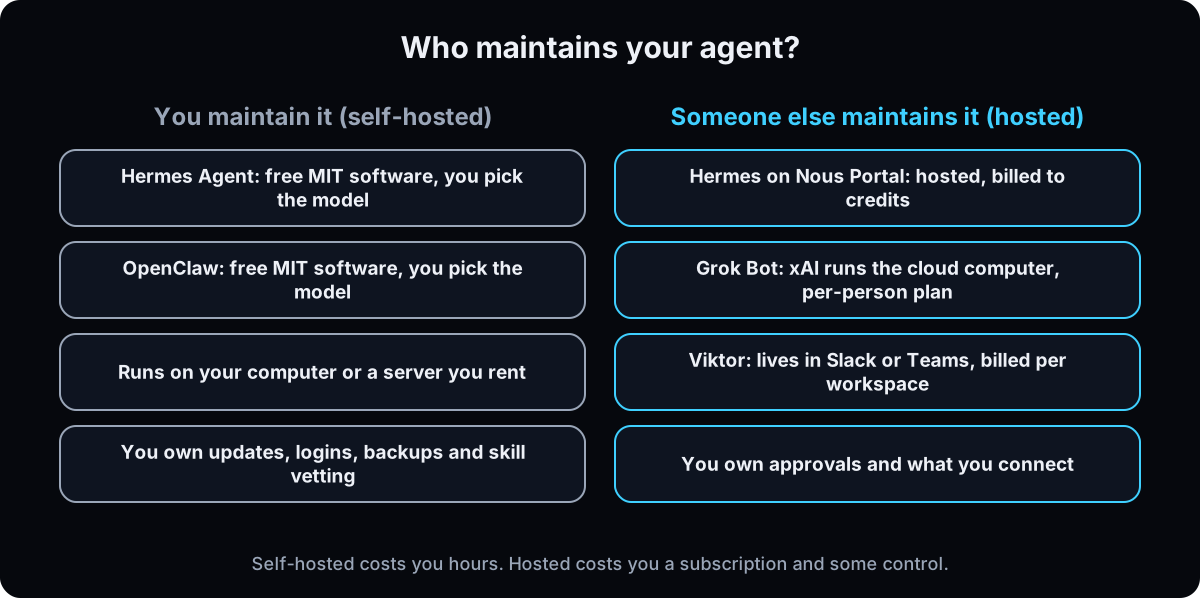
Self-hosted means you install the software on your own computer or a server you rent. Hermes Agent and OpenClaw work this way. The software is free, and you control everything.
Hosted means a company runs it for you. Grok Bot runs on xAI's cloud computer. Viktor lives inside Slack or Teams. Hermes also has a hosted option through Nous Portal. You pay a subscription and give up some control.
The catch
Free software isn't free to run. With self-hosted agents, you own the updates, the server, the logins, the backups and the job of checking every add-on before you install it. That's hours every month, and the hours land on whoever is most technical in your business. Often that's you.
Hosted agents cost money every month, and you still own the approval rules and what you connect.
Hermes vs OpenClaw vs Grok Bot vs Viktor, side by side
 Prices and plans checked 15 September 2026. Sources are linked in the steps below.
The comparison table
The table below puts the four side by side.
| Hermes Agent | OpenClaw | Grok Bot | Viktor | |
|---|---|---|---|---|
| Where it runs | Your computer, a server you rent, or hosted on Nous Portal | Your computer or a server you rent. No hosted tier from the project | xAI's cloud computer, used from the desktop and phone apps | Inside your Slack or Microsoft Teams workspace |
| What it costs | Free software. You pay for the model, or a Nous Portal plan: Free, $20, $100 or $200 a month | Free software. You pay for the model and any server | A paid xAI or Cursor plan per person. Usage resets weekly | Per workspace. Team plans $50 to $200 a month in shared credits |
| Security | Messaging is locked to an allowlist by default. The rest is on you | 255+ security advisories and a malicious skills wave in 2026. Now scanned, still on you | Approval rules built in. All your bots share one computer | Asks approval before sensitive actions. SOC 2 Type 1 |
| Memory | Built in, searchable across sessions | Built in, across conversations | Each bot keeps memory from past work | Shared context for the whole team |
| Who maintains it | Nous Research writes it. You keep your install running | The OpenClaw Foundation writes it. You keep your install running | xAI | Viktor |
| Best for | A technical owner who wants control and any model | A tinkerer who wants the biggest skill library and can vet it | One owner who wants agents without a server | A non-technical team that already lives in Slack or Teams |
| Term | What it means |
|---|---|
| Agent | AI that takes steps in your tools, not only answers questions |
| Self-hosted | You install and run the software on a machine you control |
| Hosted | A company runs the software, you pay a subscription |
| VPS | A rented server that stays on when your laptop is closed |
| Model provider | The company whose AI model does the thinking, like Anthropic, OpenAI or xAI |
| Skill | A saved add-on or set of instructions that teaches the agent a job |
| Gateway | The part that lets you message your agent from Telegram, Slack or WhatsApp |
| Allowlist | A list of the only people allowed to message your agent |
The mental model
Picking the agent with the longest feature list, then finding out 3 weeks later that nobody on your team can keep it running.
Pick by who maintains it. If a technical person owns it, self-hosted Hermes or OpenClaw gives you control. If you want one personal agent with no server, Grok Bot. If the whole team works in Slack or Teams, an AI employee in those channels, like Viktor.
| Role | Talks to you | Job |
|---|---|---|
| Hermes Agent | Telegram, Slack and 30+ messaging apps, or the terminal | Personal agent you install and control, any model |
| OpenClaw | WhatsApp, Telegram, Slack, iMessage and more | Personal agent you install, largest community skill library |
| Grok Bot | The Grok Bot desktop and phone apps | Persistent bots on xAI's cloud computer, no server to run |
| Viktor | Your Slack or Teams channels | One AI employee the whole team shares |
Isn't free always better than a subscription?
Hermes and OpenClaw are free. Why would a small business pay for Grok Bot or Viktor?
Because the software is free and the upkeep isn't. Price the hours, not only the license.
- Model costs don't go away. Self-hosted agents still pay a model provider for every task.
- A server costs money if you want it running with your laptop closed.
- Updates and fixes are yours. OpenClaw alone lists over 700 published fixes on its security page.
- Every add-on is a trust decision you make. OpenClaw says third-party skills sit outside its security guarantees.
If you have a technical person who enjoys that work, free wins. If you don't, the subscription is often cheaper than your time.
How to choose, in 5 decisions
1. Decide who will maintain it
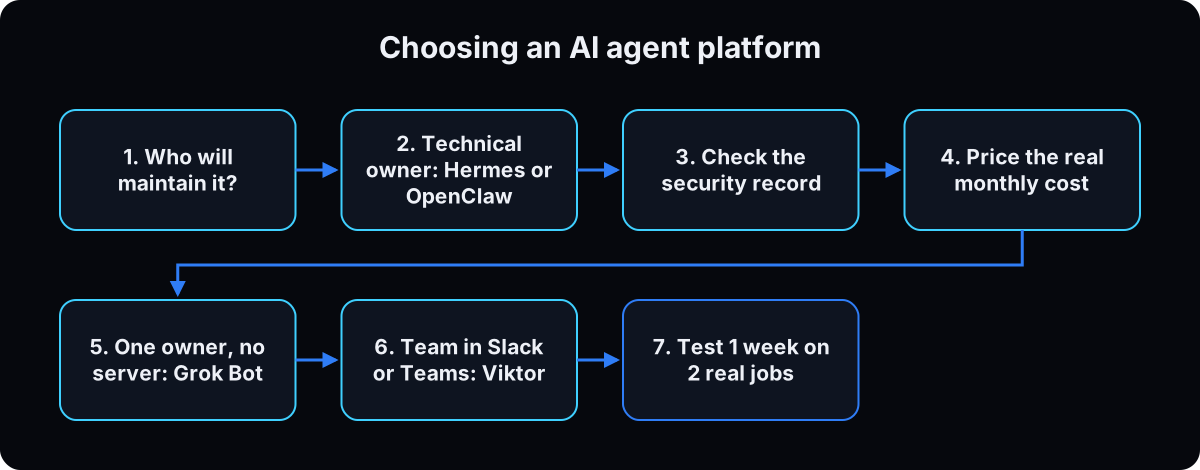 Name the person who will install updates, fix a broken login and check add-ons. If that name is "nobody" or "me, when I have time", rule out self-hosting now and skip to step 3.
Why: this one answer rules out half the options. Self-hosted agents stop working quietly when nobody owns them. I moved off Hermes for this reason, not because of anything the software did wrong.
2. If someone technical owns it: Hermes or OpenClaw
Hermes Agent is free, MIT-licensed software from Nous Research. It runs on Linux, macOS, Windows and WSL2, per the install docs, keeps memory across sessions, and its messaging gateway connects to 30+ apps including Telegram, Slack, WhatsApp and Microsoft Teams. It blocks anyone not on an allowlist by default.
OpenClaw is free, MIT-licensed software stewarded by the OpenClaw Foundation, with no paid or hosted tier. It installs with one command per the OpenClaw docs, connects to WhatsApp, Telegram, Slack, iMessage and more, and has the ClawHub skill marketplace.
Why: both give you full control and any model. Pick Hermes if you want a tighter default setup. Pick OpenClaw if the skill library matters most and you'll vet every skill. My Hermes setup guide covers the install order that holds.
3. Check the security record before you install anything
IBM X-Force reported in April 2026 that OpenClaw had published over 255 GitHub security advisories and that a campaign called ClawHavoc uploaded over 1,100 malicious skills to ClawHub, disguised as productivity, crypto or coding tools. A flaw called ClawJacked let malicious websites take over local installs until version 2026.2.26.
OpenClaw has responded. Its security page (checked 15 September 2026) says ClawHub skills are now scanned, including with VirusTotal, and lists 14 confirmed critical vulnerabilities, all fixed. The same page says third-party skills are outside its security guarantees.
Why: an agent can read your files, browse the web and send messages. Any agent with that access, Hermes included, needs the rules in my guardrails guide: its own accounts, read-only first, and approval before anything sends or spends.
4. Price the real monthly cost
Hermes: free software, plus your model provider. Or use Nous Portal: Free, Plus $20, Super $100 or Ultra $200 a month in credits, checked 15 September 2026. Portal can also host your Hermes agent in the cloud, with server costs billed to the same credits.
OpenClaw: free software, plus your model provider and a server if you want it always on.
Grok Bot: needs a paid plan. xAI's get started guide lists SuperGrok Plus, SuperGrok Heavy, Cursor Pro+, Cursor Ultra, and Cursor Teams Standard or Premium, with usage resetting weekly. Check current plan prices on xAI's site.
Viktor: Team plans of $50, $75, $100 and $200 a month for 20,000 to 80,000 shared credits, per Viktor's pricing page, checked 15 September 2026.
Why: then add your hours. One hour a week of upkeep is 4 or more hours a month.
5. No server and one owner: Grok Bot wins
Grok Bot gives you persistent bots on a cloud computer with a browser, files and a terminal, per xAI's overview. It keeps working with your laptop closed, has approval rules built in, and runs on Mac, Windows and Linux with phone apps.
One catch: all your bots share one computer and its logins, and xAI's security docs say not to treat separate bots as a security boundary.
Why: for a solo owner who wants agents without running a server, it's the shortest path. Set up your first Grok agent here.
6. When Viktor is the better pick
If your agency or clinic team already works in Slack or Microsoft Teams and nobody wants to be the agent's IT department, Viktor fits better than all three. It lives inside your channels, bills per workspace with one shared credit pool instead of a plan per person, connects to 3,200+ tools with one-click logins, and asks for approval before sensitive actions, per Viktor's integrations page. There's no server to maintain.
That's why I run 6 Viktor agents for my team. The trial is $100 in credits with no card on Viktor's site, or $150 through my affiliate link.
When Viktor isn't the pick: you're a solo owner with no team channels (Grok Bot fits), you need a model or a local setup Viktor doesn't offer (Hermes), or you want to tinker with community skills (OpenClaw). My Viktor review and Slack setup guide go deeper.
Why: for a non-technical team, the cheapest agent is the one nobody has to babysit.
7. Test your pick for one week on 2 real jobs
Before you commit, run your pick on 2 jobs you do every week, like a morning inbox brief and a client report draft. Keep every send, post and spend behind your approval.
Why: a week shows you the upkeep, the cost and whether the output is usable. If it isn't, you've lost a week, not a quarter.
Job 1: [a weekly job, like a morning inbox brief]
Job 2: [another weekly job, like a client report draft]
Pass test: [what a usable result looks like]
Hours I spent fixing or maintaining it this week: [ ]
What it cost this week: [ ]
Keep, switch or stop: [ ]
If this happens, do this
Every one of these has happened to me or to someone I set this up for.
| Failure | Fix |
|---|---|
| You installed a self-hosted agent and nobody updates it | Name an owner, or move to a hosted option |
| You installed a ClawHub skill without reading it | Remove it, check the skill's origin and scan result, and rotate any keys it could reach |
| Your agent can send email without asking | Add an approval rule for every send, post, spend and delete |
| You bought a Grok Bot plan for every teammate | If the team works in Slack or Teams, compare per-workspace billing first |
| Model bills surprise you on a free agent | Set a spending limit with your model provider before you connect it |
| You're comparing features for a week | Answer step 1 and let it rule options out |
The tools I use for this
| Tool | What it is for here | |
|---|---|---|
| Hermes Agent | Free, open-source personal agent from Nous Research. | Read |
| Nous Portal | Model credits, hosted tools and cloud hosting for Hermes. | Open |
| OpenClaw | Free, open-source personal agent from the OpenClaw Foundation. | Read |
| OpenClaw security | The project's own trust model and fix record. | Read |
| Grok Bot docs | xAI's official setup, plans and security documentation. | Read |
| Viktor † | The AI employee in Slack or Teams. My link adds $150 in trial credits. | Start free |
Questions people ask
Which is better, Hermes or OpenClaw?
Neither wins for everyone. Both are free, MIT-licensed and self-hosted. Hermes suits a technical owner who wants tighter defaults, like its messaging allowlist. OpenClaw suits someone who wants the biggest community skill library and will vet every skill. If nobody on your team wants to maintain either, pick a hosted option.
Is OpenClaw safe to use?
It can be, with care. IBM X-Force reported over 255 security advisories and over 1,100 malicious ClawHub skills in early 2026. OpenClaw now scans skills and lists its critical fixes on its security page, but third-party skills stay your responsibility. Use its own accounts, install few skills, and require approval for anything that sends or spends.
Is Hermes Agent free?
The software is free under the MIT license. You still pay for the AI model you connect, and for a server if you want it always on. Nous Portal has a free tier with free models and paid plans of $20, $100 and $200 a month, checked 15 September 2026.
Grok Bot vs Hermes: which should I use?
Grok Bot if you want persistent agents with no server to run and you're fine on an xAI or Cursor plan. Hermes if you want to choose any model, run it on your own machine and don't mind the upkeep.
What's the best AI agent for a team?
For a non-technical team that works in Slack or Microsoft Teams, an AI employee inside those channels, like Viktor, is usually easier: it bills per workspace and there's no server to maintain. Hermes, OpenClaw and Grok Bot are built mainly around one owner.
The free skill
It asks who will maintain the agent, what jobs it needs to do and where the team already works, then recommends Hermes, OpenClaw, Grok Bot or Viktor with the honest reason and a 1-week test plan. Related guides: set up Hermes, set up Grok Bot, set up Viktor in Slack and agent guardrails.
---
name: hermes-vs-openclaw-vs-grok-bot
description: Helps a business owner pick an AI agent platform: Hermes Agent, OpenClaw, Grok Bot or Viktor. Decides by who will maintain it, real monthly cost, security record and where the team already works, then sets a 1-week test on 2 real jobs. Trigger on "which ai agent should i use", "hermes vs openclaw", "openclaw vs hermes", "grok bot vs hermes", "grok bot vs openclaw", "is openclaw safe", "best ai agent for my team".
---

# Hermes vs OpenClaw vs Grok Bot

Help the user choose one AI agent platform for their business and prove it in a week. Decide by who keeps it running, not by the longest feature list.

## When to use
- They're comparing Hermes Agent, OpenClaw, Grok Bot or Viktor.
- They ask if OpenClaw is safe, if Hermes is free, or what's best for a team.
- Not for setting one up step by step. Point to the setup guides for that.

## If they're new, explain this first
- **Agent:** a chatbot writes the email; an agent opens the inbox, drafts the reply and waits for a yes.
- **Self-hosted:** they install and run it (Hermes, OpenClaw). Free software, but they own updates, server, logins, backups and vetting add-ons.
- **Hosted:** a company runs it (Grok Bot, Viktor, Hermes on Nous Portal). A subscription, less control.
- **The catch:** free software still costs model fees and hours.

## Facts (checked 15 September 2026, recheck prices)
- **Hermes Agent:** Nous Research, MIT license. Linux, macOS, Windows, WSL2. Memory across sessions. Gateway to 30+ messaging apps (Telegram, Slack, WhatsApp, Teams), allowlist by default. Nous Portal: Free, Plus $20, Super $100, Ultra $200 a month in credits; can host the agent in the cloud billed to credits.
- **OpenClaw:** OpenClaw Foundation, MIT license, no paid or hosted tier. WhatsApp, Telegram, Slack, iMessage and more. ClawHub skill marketplace. IBM X-Force (April 2026): 255+ security advisories, 1,100+ malicious skills in the ClawHavoc campaign, ClawJacked fixed in 2026.2.26. openclaw.ai/security: skills now scanned (including VirusTotal), 14 confirmed critical vulnerabilities fixed, third-party skills outside its guarantees.
- **Grok Bot:** xAI. Persistent bots on a shared cloud computer (browser, files, terminal). Plans: SuperGrok Plus, SuperGrok Heavy, Cursor Pro+, Cursor Ultra, Cursor Teams Standard or Premium. Usage resets weekly. All bots share one computer, not a security boundary. Don't quote plan prices unless checked on xAI's site that day.
- **Viktor:** AI employee in Slack or Microsoft Teams. Per-workspace billing, shared credits. Team plans $50/$75/$100/$200 for 20k/30k/40k/80k credits. 3,200+ integrations. Asks approval before sensitive actions. SOC 2 Type 1. Trial $100 credits no card, $150 via https://ref.viktor.com/emeka-ajufo (affiliate link, say so).

## Decide in order
Ask one question at a time.
1. **Who will maintain it?** If nobody technical, rule out self-hosting.
2. **Someone technical owns it:** Hermes for tighter defaults and any model; OpenClaw for the biggest skill library, only if they'll vet every skill.
3. **Security:** any agent gets its own accounts, read-only first, approval before sends, posts, spends and deletes. Few add-ons, each checked.
4. **Real monthly cost:** model fees + server + plan + hours of upkeep.
5. **One owner, no server wanted:** Grok Bot.
6. **Team already in Slack or Teams, non-technical:** Viktor. Honest reason: per-workspace billing and no server to maintain. Not Viktor if they're solo with no team channels (Grok Bot), need a model or local setup Viktor doesn't offer (Hermes), or want to tinker with community skills (OpenClaw).
7. **Test 1 week on 2 real jobs** with approvals on. Log hours and cost. Keep, switch or stop.

## Rules
- Never invent prices, CVE counts or features. If unsure, say check the official page.
- Never recommend installing an unvetted skill.
- Every send, post, spend or delete waits for an exact yes.
- No passwords, keys or patient information in chat.

## Test week template
> Job 1: [weekly job]. Job 2: [weekly job]. Pass test: [usable result]. Hours spent maintaining it: [ ]. Cost this week: [ ]. Keep, switch or stop: [ ].

## Done when
They've named who maintains it, picked one platform with the real reason, and have 2 jobs running behind approvals for a week.
Want help picking and setting it up?
Most owners lose a month comparing agents. Inside AI CEO Lab we pick yours in one session, set the approval rules, and get 2 real jobs running in the first week.